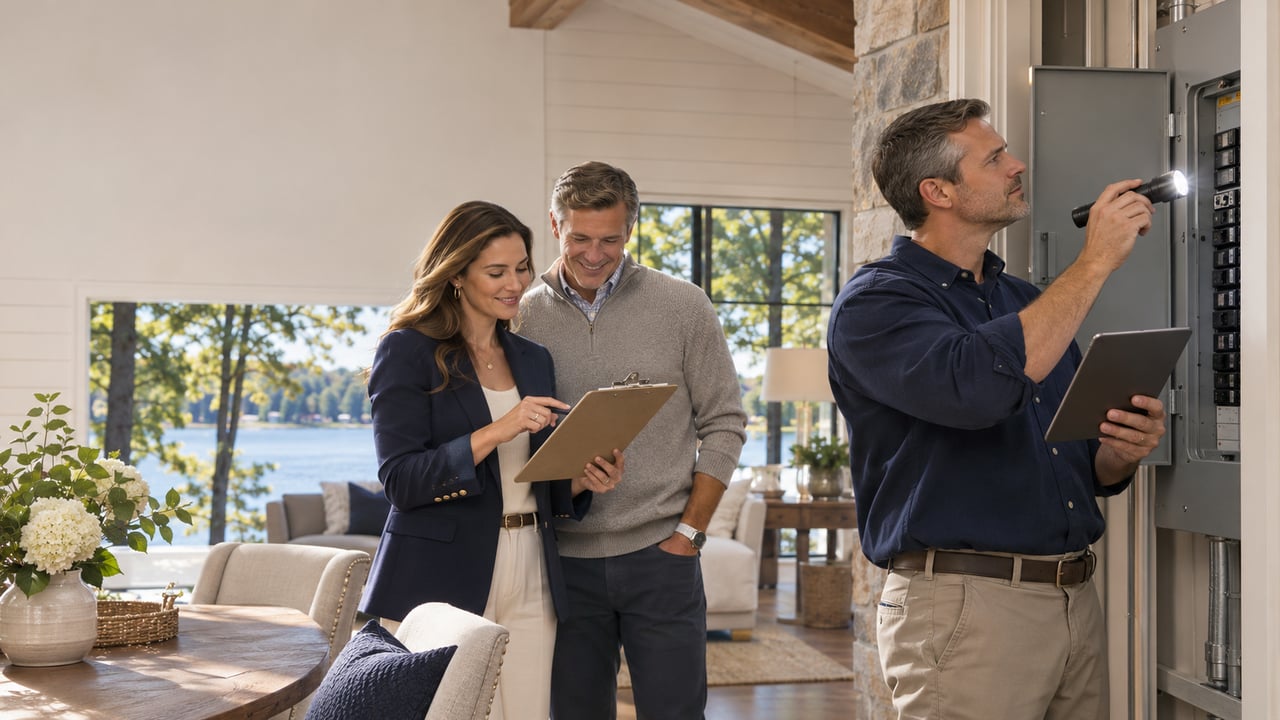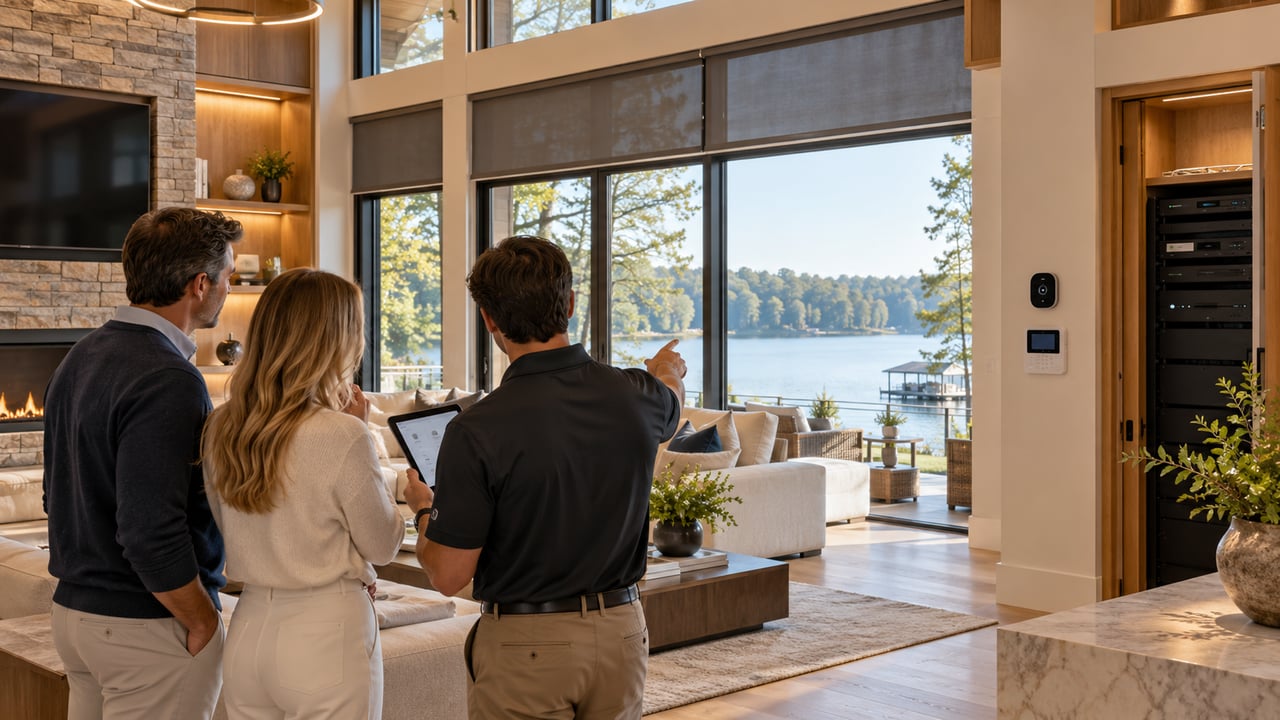
In a luxury home, technology often disappears into the architecture. Lighting scenes activate from a keypad. Shades lower automatically. Cameras, climate zones, audio, gates, pool equipment, and irrigation may all run through apps or a central system.
That convenience can be valuable, but a quick demonstration during a showing does not tell you whether the system is complete, supported, transferable, secure, or easy to operate. Before closing on a smart home around Lake Norman, buyers should evaluate the technology with the same care they give the roof, HVAC, pool, and dock.
Here is a practical way to understand what you are buying and prepare for a clean handoff.
Start with a complete technology inventory
Ask the seller to identify every connected or automated component that will remain with the property. The list may include:
- Lighting controls, dimmers, switches, and programmed scenes
- Motorized shades, gates, garage doors, and door locks
- Thermostats, HVAC zoning controls, sensors, and air-quality monitors
- Security panels, cameras, video doorbells, and access-control equipment
- Distributed audio, televisions, speakers, and home-theater components
- Network equipment, wireless access points, switches, and equipment racks
- Pool, spa, irrigation, water-leak, generator, and energy-monitoring controls
- Appliances, EV chargers, solar equipment, and battery storage
The Federal Trade Commission recommends that smart-home sellers create a device list and leave manuals because some connected items—such as bulbs, sensors, and switches—may not be obvious to the next owner. Its smart-home transfer guidance is a useful starting point.
Match the inventory to the purchase agreement. Confirm which screens, hubs, remotes, racks, cameras, speakers, chargers, and other components are included rather than assuming every visible item conveys.
Test functions, not just touchscreens
A polished control panel can mask disconnected equipment or incomplete programming. During inspections or a dedicated systems demonstration, test the actual functions: lights, shades, locks, gates, cameras, thermostats, speakers, irrigation zones, pool controls, and backup power.
Ask whether the home still works when the internet is unavailable. Essential systems should not become confusing or unusable because an app, cloud service, or subscription is interrupted. Identify physical switches, manual releases, local controls, and emergency procedures.
For climate technology, verify that the controller is compatible with the home’s actual HVAC equipment. ENERGY STAR notes that compatibility can be more involved with variable-speed, multi-stage, or zoned systems and recommends professional input when needed. Review the agency’s smart-thermostat guidance.
Understand the home’s digital backbone
Smart devices depend on the network. A large home may need several wired access points rather than a single consumer router. Locate the incoming internet service, modem or gateway, router, switches, structured wiring, access points, equipment rack, and battery backups.
Ask who designed and services the system, whether wiring diagrams exist, and whether unused cables are labeled. Confirm which network equipment remains and whether any piece is leased from an internet provider.
After closing, create a new network name and strong passwords, enable encryption and two-factor authentication where available, update device software, and review every connected device. The FTC’s connected-device security guide also recommends changing default credentials, checking updates, and disabling features you do not use.
Review accounts, subscriptions, and support
The hardware may remain while the service does not. Security monitoring, camera recording, gate access, whole-home audio, automation platforms, internet service, pool monitoring, and energy-management tools may require separate subscriptions.
For each system, ask:
- Is an active subscription required?
- Can the account transfer, or must the buyer establish a new one?
- Are warranties and service agreements transferable?
- Is the system still supported by its manufacturer or installer?
- Are replacement parts and qualified technicians available locally?
- Does the system depend on an account controlled by the seller, builder, or integrator?
Obtain installer information, model numbers, serial numbers, manuals, programming files, warranties, invoices, and service history when available. A sophisticated system without documentation can be harder and more expensive to maintain.
Verify electrical capacity and permits
Smart-home convenience often overlaps with major electrical equipment. EV chargers, generators, transfer switches, battery systems, gates, pool controls, and dedicated equipment racks deserve closer review.
For an EV charger, identify its rating, circuit size, connector type, location, and whether the electrical service can support the buyer’s vehicle and future plans. The U.S. Department of Energy’s home-charging guide recommends safety-certified equipment, qualified installation, and confirmation of available electrical capacity.
Review permits and inspections for permanently installed electrical systems. Mecklenburg County states that changes and additions to permanent wiring are generally subject to permitting and inspection. It also requires permits and inspections when a generator connects to a building’s permanent wiring.
Plan the ownership transfer before closing day
The technology handoff should be scheduled, documented, and tested. The seller should remove personal data and administrative access, cancel or transfer applicable services, and factory-reset connected devices. The buyer should then establish new accounts, credentials, codes, users, privacy settings, and emergency contacts.
Coordinate carefully with security cameras, door locks, gates, garage doors, and alarm systems so the property remains secure throughout the transition. After setup, confirm that former users, phones, voice assistants, and remote accounts no longer have access.
Conduct a final walkthrough of the technology just as you would the physical home. Confirm that included equipment remains in place, systems operate, manuals and credentials are available, and agreed repairs or updates are complete.
Luxury technology should make ownership simpler
The best smart-home systems feel intuitive. They have clear documentation, reliable local controls, current support, secure accounts, and a network designed for the property. Complexity by itself is not luxury; dependable operation is.
If you are evaluating a luxury, waterfront, new-construction, or resale home in Huntersville, Cornelius, Davidson, or the greater Lake Norman and Charlotte area, contact Austin Quick to create a property-specific due-diligence plan before closing.
Source notes
- Federal Trade Commission: Buying or Selling a Smart Home
- Federal Trade Commission: Securing Internet-Connected Devices
- ENERGY STAR: Smart Thermostats
- U.S. Department of Energy: Charging Electric Vehicles at Home
- Mecklenburg County: Electrical Information for Homeowners
- Mecklenburg County: Generator Safety
Information and links were reviewed November 2, 2026. Device support, subscriptions, transfer procedures, permits, and electrical requirements vary by property, manufacturer, and jurisdiction.
Header image: Conceptual AI-generated editorial imagery; it does not depict an actual Lake Norman property, listing, client, technology company, or control system.