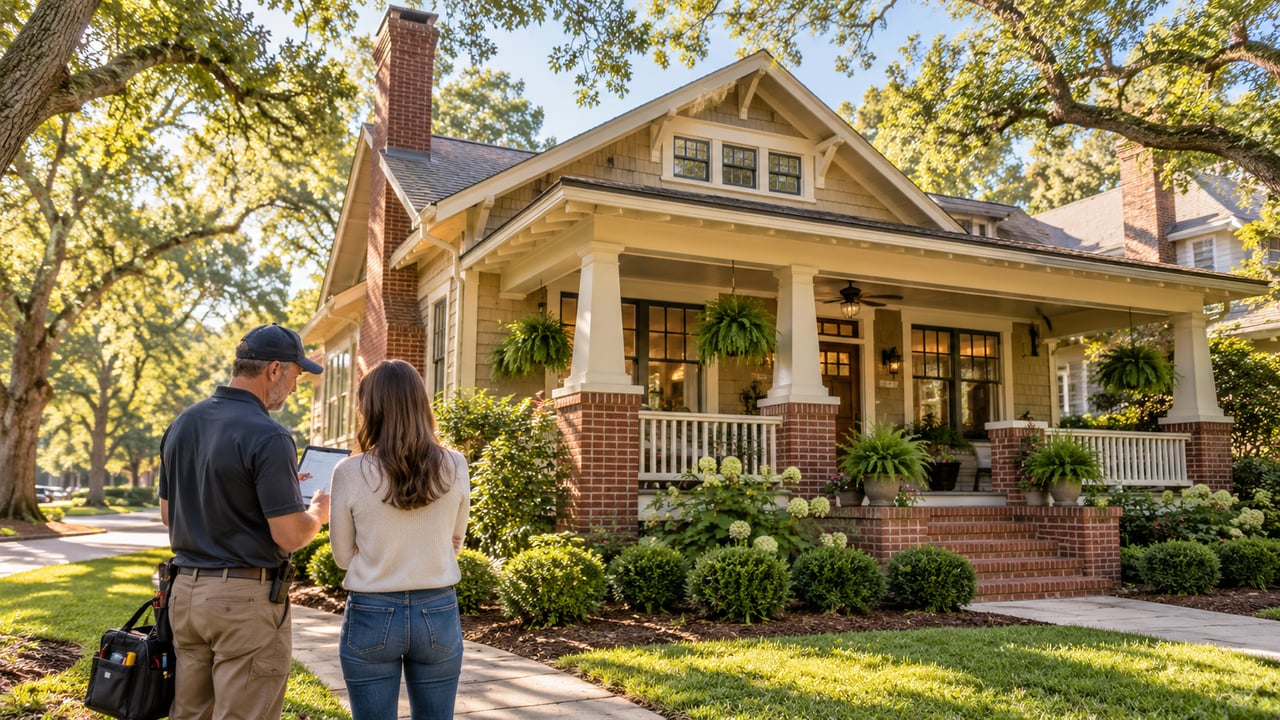
Older homes can offer details that are difficult to reproduce: mature landscaping, established streets, substantial trim, inviting porches, and architecture with a clear sense of place. Around Davidson, Huntersville, Cornelius, and Charlotte, those qualities can make a resale home stand apart from newer construction.
Age alone is neither a defect nor a guarantee of craftsmanship. What matters is how the home has been maintained, altered, and documented. The best approach is to appreciate the character while investigating the systems, structure, permits, and rules that will shape ownership.
Here is a practical framework for evaluating an older home during North Carolina’s due-diligence period.
First, determine whether “historic” has a legal meaning
Marketing sometimes uses “historic” as shorthand for an older or architecturally distinctive home. A formal designation is different.
Davidson, for example, has both a local historic district and a larger National Register district. The town explains that properties in the local district require approval for many exterior changes through a Certificate of Appropriateness, while National Register recognition generally does not restrict a private owner unless a federal benefit is involved. Buyers can review the district map and current standards on the Town of Davidson’s Historic Preservation page.
Before making renovation plans, confirm whether the property is within a local district, listed as a landmark, located only within a National Register district, or simply older. Then ask which parts of the property are regulated and whether past exterior work received the necessary approval.
Build the inspection around the home—not its age
A standard home inspection is the starting point. The North Carolina Real Estate Commission notes that an inspection is visual and not technically exhaustive; when a general inspector identifies a concern, buyers may need qualified specialists to evaluate it further. Its consumer home-inspection guide explains what an inspection covers and what buyers should expect.
For an older home, pay close attention to:
- Foundation movement, crawl-space moisture, grading, and drainage
- Roof covering, flashing, chimneys, gutters, and signs of prior leaks
- Electrical service, panels, wiring types, grounding, and available capacity
- Supply piping, drain lines, water pressure, sewer or septic connection
- Heating and cooling equipment, ductwork, insulation, and ventilation
- Window condition, exterior wood, masonry, porches, and railings
- Evidence of additions, removed walls, finished attics, or converted spaces
No single list fits every property. An experienced inspector can identify where a structural engineer, electrician, plumber, HVAC contractor, chimney professional, roofer, pest specialist, or other expert may be appropriate.
Compare the physical home with the permit history
Older homes often evolve. A porch may become conditioned space, an attic may become a bedroom, or a rear addition may change the original floor plan. Those changes can be valuable, but buyers should verify how and when they were completed.
Mecklenburg County allows users to search recent building, electrical, mechanical, and plumbing permits through its Code Enforcement permitting page. Its public-record resources also include certain certificates and permit documents, although online retention periods are limited. For older work, buyers may need help from the county, town planning staff, the seller, or a closing attorney.
Compare the listing, tax record, survey, floor plan, and visible improvements. Ask whether additions were permitted, whether inspections were finalized, and whether the reported square footage follows current North Carolina guidance. Missing records do not automatically prove defective work, but they can affect renovation plans, insurance, appraisal, and resale.
Address environmental questions thoughtfully
Most housing built before 1978 is subject to federal lead-based-paint disclosure requirements. The EPA explains that sellers must disclose known information and provide available records, the federal pamphlet, and a lead warning statement for covered housing; buyers must also receive an opportunity to conduct a lead evaluation. Review the EPA’s lead information for homebuyers.
Some older building materials may also contain asbestos. You cannot confirm that by appearance alone. The EPA recommends professional sampling when suspect material is damaged or when planned renovation would disturb it, as explained in its guidance for home remodeling.
Radon is unrelated to architectural age, so a newer-looking renovation does not answer the question. The North Carolina Radon Program recommends testing every home and provides guidance on certified professionals and test kits.
Price the ownership plan, not only the repair list
Inspection findings should become a prioritized ownership plan. Separate immediate safety or water-intrusion concerns from routine maintenance and optional improvements. Then obtain realistic estimates for the items that materially affect your decision.
Contact an insurance professional early. The home’s roof, electrical, plumbing, heating systems, prior claims, replacement cost, and historic features may influence coverage options. If you plan a major renovation, speak with your lender, insurer, designer, contractor, and local planning staff before assuming the work is feasible.
For historically regulated exteriors, details such as window replacement, porch changes, additions, demolition, fencing, and exterior materials may require review. A renovation budget should account for design requirements as well as construction cost.
Use the due-diligence period deliberately
North Carolina’s due-diligence period is the buyer’s opportunity to investigate the property and transaction. The Real Estate Commission recommends reviewing documents, asking questions, and ordering inspections early enough to make an informed decision. Its due-diligence guide is a useful overview.
An older home can be an excellent purchase when its condition, rules, and future needs align with your expectations. The objective is not to remove every unknown. It is to identify the meaningful ones, understand their cost and impact, and decide with clear information.
If you are considering an older, renovated, or historic-character home in Davidson, Huntersville, Cornelius, Charlotte, or elsewhere around Lake Norman, contact Austin Quick to create a property-specific due-diligence plan before the contract clock starts.